
Generative AI Military Intelligence: How AI Is Redefining Global Security

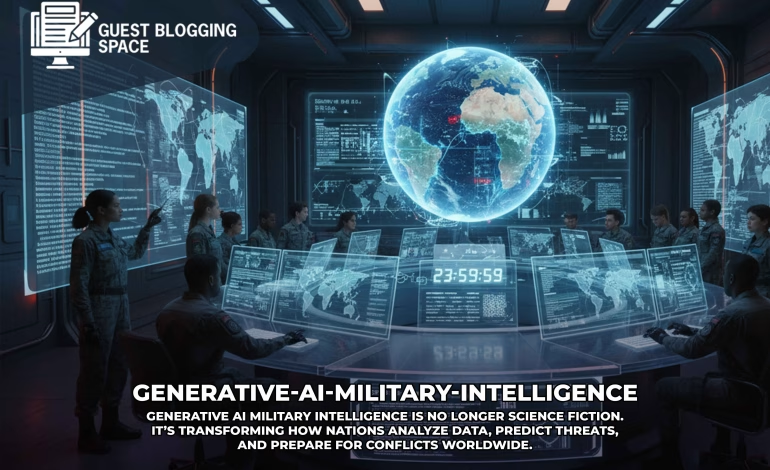
Generative AI military intelligence is no longer science fiction. It’s transforming how nations analyze data, predict threats, and prepare for conflicts worldwide. Nations now rely on AI to simulate scenarios, forecast risks, and enhance decision-making faster than ever.
Something strange is happening around us. Most people still have no idea how powerful this shift truly is. Today, we explore how generative AI is quietly reshaping global security.
Something strange is happening around us. Nations are no longer competing only through weapons, borders, or battlefield strength. They are competing through algorithms.
Generative AI has moved from viral apps and funny filters into the deepest corners of global defense.
It’s analyzing signals.
It’s predicting threats.
It’s simulating conflicts before a single shot is fired.
And here’s the twist:
Most people still have no idea how powerful this shift truly is.
Today, we explore Generative AI in military intelligence, how it works, why countries fear it, and how it’s silently reshaping global power.
What Is Generative AI Military Intelligence?
Generative AI military intelligence refers to the use of advanced AI models that create new insights, predictions, and simulations from massive data streams.
These systems don’t just identify patterns. They generate scenarios, probabilities, and possibilities.
In simple words:
It’s like giving analysts a supercomputer that thinks, predicts, and imagines outcomes at an impossible scale.
Why Countries Are Racing Toward Generative AI
Speed Is the New Power
Modern conflicts move fast.
Decisions must be made within minutes.
Human analysis alone can’t keep up.
Generative AI changes that.
It processes satellite images, communication signals, and digital footprints in seconds. It turns overwhelming data into meaningful predictions. The nation that reacts faster often wins without fighting.
Data Has Become the New Battlefield
Every country produces oceans of information daily.
From drones.
From radars.
From cyber networks.
From online activity.
But raw data is useless without interpretation. Generative AI filters noise. It highlights hidden dangers. It identifies trends invisible to the human eye.
For governments, this is not a luxury. It’s survival.
How Generative AI Is Used in Military Intelligence
Below are real, safe, non-classified applications used worldwide. No operational details. Only high-level insights.
1. Predictive Threat Modeling
Seeing danger before it arrives
Generative AI builds predictive models that show where conflicts may rise. It scans economic signals, political tension, weather patterns, and shifting behavior. Then it generates potential future scenarios.
For example:
If trade routes shift, AI predicts how security might change.
If cyberattacks increase, it forecasts likely next targets.
Analysts get a map of risks before they become real.
2. Intelligence Brief Generation
Turning complex data into simple insights
Intelligence agencies receive endless reports.
Most are long.
Most arrive fast.
Most require hours of human review.
Generative AI acts like an assistant that never sleeps.
It summarizes updates.
It highlights anomalies.
It translates foreign communications instantly.
Humans still decide the truth.
AI only accelerates the process.
3. Synthetic Battlefield Simulations
Conflict without casualties
Military planners use generative AI to simulate crisis scenarios.
These simulations involve terrain, weather, logistics, and potential enemy actions.
They allow analysts to study outcomes safely.
Imagine testing thousands of hypothetical events in a single afternoon.
That’s the power generative AI brings.
4. Cyber Defense Enhancement
Learning from fake attacks
Cybersecurity is now a frontline.
A single hack can cripple entire countries.
Generative AI helps by generating synthetic threats.
It creates sample malware.
It simulates attack paths.
It tests defense systems without real danger.
This prepares nations for the next wave of cyberwarfare.
5. Logistics and Resource Optimization
Moving smarter, not harder
Wars often depend on supplies, not weapons.
Fuel.
Food.
Transport routes.
Maintenance cycles.
AI analyzes weather, traffic, terrain, and historical patterns.
It then generates optimized routes and schedules.
This reduces cost and increases readiness.
The Ethical Side: Why Experts Are Nervous
Generative AI is powerful, but it brings heavy responsibilities.
Risk 1: AI Hallucination
AI sometimes creates confident but wrong conclusions.
In defense, a small mistake can lead to huge consequences.
Humans must verify everything.
Risk 2: Data Manipulation
If adversaries feed false data into AI systems, they can mislead entire intelligence networks.
Security teams constantly guard against this threat.
Risk 3: Overreliance on Algorithms
Decision-makers may trust AI too much.
This can create false confidence, especially in unpredictable situations.
Balance is essential.
Risk 4: Escalation Anxiety
If AI predicts a threat incorrectly, countries might act too aggressively.
This makes responsible use extremely important.
Which Countries Lead in Generative AI Military Intelligence?
No secret details. Only global trends.
The United States
Massive investment in AI-enabled defense systems.
Heavy focus on partnerships between government and private tech companies.
China
Rapid development of surveillance AI, cyber defense, and predictive modeling.
Strong focus on automation.
India
Expanding AI research in defense analytics and military modernization.
European Union
Focus on ethical AI, accountability, and multi-nation defense collaboration.
Middle East
Growing investment in surveillance AI, border technology, and predictive defense tools.
Why This Topic Matters to Everyday People
Generative AI in military intelligence affects civilians in many hidden ways.
- It influences national stability.
- It shapes global alliances.
- It defines cybersecurity protection.
- It impacts peace negotiations.
- It affects how nations prepare for natural or political crises.
You may not see it daily, but it shapes the world around you.
We Are Living in a Predictive World
Generative AI is reshaping military intelligence faster than we expected. Countries are upgrading their systems. Analysts are working with AI assistants. And global strategies are shifting toward algorithmic prediction. This technology won’t replace humans. But it will redefine how nations understand risk, prepare for conflict, and protect their futures.
We are entering an era where data decides direction, and AI becomes the compass. Understanding this shift is no longer optional. It’s essential.
FAQs: Generative AI Military Intelligence
Q1: What exactly does generative AI do in military intelligence?
Generative AI military intelligence works by spotting potential threats before they escalate, sifting through massive amounts of incoming data, building realistic what-if scenarios, and giving analysts the kind of rapid insights that would take humans days or weeks to piece together on their own.
Q2: Can generative AI control weapons or make combat decisions?
Not at all. Global ethical standards are clear on this—human operators must maintain final authority over any life-or-death calls, even when generative AI military intelligence is part of the decision-making process.
Q3: Is generative AI replacing military analysts?
No, that’s not how it works. Generative AI military intelligence doesn’t make the calls—it’s there to help analysts by pulling together summaries, forecasting potential scenarios, and running simulations based on the data they’re working with.
Q4: Is this technology used globally?
Absolutely. You’re seeing nations around the world pouring massive resources into generative AI military intelligence systems because they know the strategic advantage is too significant to ignore.
Q5: Does generative AI increase or decrease global security?
Generative AI military intelligence cuts both ways. Yes, it sharpens readiness and helps forces stay ahead of threats, but it also opens the door to serious problems—like spreading false information or creating a dangerous dependency on automated systems.







1 Comment
Really insightful article! Seeing platforms like bigbunny game apk focus on localized payment options (GCash, PayMaya) is smart for the Filipino market. Makes access so much easier! What are your thoughts on responsible gaming features?