
The Quantum Revolution Inches Forward: What Google’s Willow Chip Really Means for Our Future

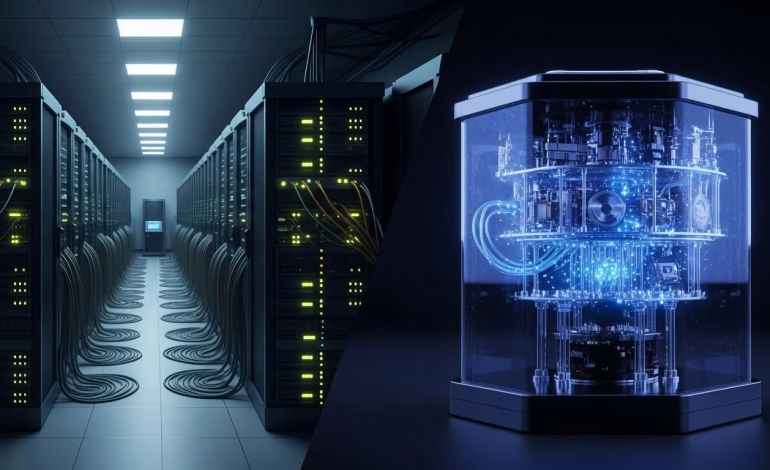
Imagine solving a problem in minutes that would take the world’s fastest supercomputer longer than the universe has existed. Quantum computing promises exactly that kind of mind-bending power. Google just announced their Willow quantum processor, and the tech world is buzzing about whether we’re finally approaching a genuine breakthrough or witnessing another round of overhyped promises.
The truth sits somewhere between miracle and mirage, and understanding what’s really happening requires cutting through the marketing speak to examine what quantum computing actually delivers today.
When Error Becomes the Enemy
Every computer makes mistakes. Your laptop occasionally freezes or crashes because tiny electrical fluctuations corrupt data. Classical computers handle this through redundancy and error-checking protocols that work reliably because the errors are rare and predictable.
Quantum computers face a fundamentally different challenge. Their basic units of information, called qubits, are extraordinarily fragile. They exist in a bizarre quantum state where they’re simultaneously representing multiple values at once, a property called superposition. This gives quantum computers their potential power, but it also makes them incredibly vulnerable.
Think of a qubit like a spinning coin suspended in mid-air. The slightest vibration, temperature change, or electromagnetic interference can knock it over, destroying the delicate quantum information it carries. Even cosmic rays from outer space can disrupt quantum calculations.
For decades, researchers have wrestled with a cruel irony. Adding more qubits should make quantum computers more powerful, but it also introduces more errors. Every new card makes the structure more impressive but also more likely to collapse.
This is where Google’s Willow processor claims to change the game. Instead of errors multiplying as they added more qubits, their system actually reduced errors. They tested arrays of increasing size and each time the error rate dropped by half. Going from a small grid to a larger one made the system more stable, not less.
This achievement, known in the field as being “below threshold,” represents progress scientists have pursued since 1995. It suggests that building large-scale, reliable quantum computers might actually be possible, not just theoretical.
The Septillion-Year Showdown
Google tested Willow using something called random circuit sampling. This benchmark essentially asks the quantum computer to perform a specific type of calculation that’s designed to be extremely difficult for classical computers to verify or replicate.
The results sound like science fiction. Willow completed this calculation in under five minutes. Google estimates that Frontier, one of the world’s fastest supercomputers, would need 10 septillion years to perform the same task. That’s a 1 followed by 25 zeros. It’s longer than the age of the universe by an incomprehensible margin.
Before we get too excited, we need context. Random circuit sampling doesn’t solve any practical problem. It’s specifically designed to showcase quantum advantage, but it has no known commercial applications. It’s like building a car that can drive at 1,000 miles per hour but only on a specially constructed test track that leads nowhere.
This doesn’t make the achievement meaningless. Random circuit sampling serves as a proof of concept, demonstrating that quantum computers can outperform classical systems at specific tasks. But there’s a massive gap between excelling at a benchmark test and solving real problems that matter to businesses, scientists, or society.
Critics point out that classical algorithms keep improving too. When Google claimed quantum supremacy with their earlier Sycamore processor, researchers later developed classical algorithms that significantly narrowed the performance gap. The same could happen with Willow’s benchmark results.
The quantum computing field has a history of moving goalposts. Each time classical computers catch up to quantum achievements, researchers design new benchmarks that favor quantum systems. This creates an ongoing race rather than a definitive winner.
Beyond the Hype: Real Challenges Remain
Willow operates at temperatures colder than outer space, requiring sophisticated refrigeration systems that consume substantial energy. The entire apparatus fills a small room and costs millions of dollars. It requires constant calibration and maintenance by highly trained specialists.
Each qubit in Willow can maintain its quantum state for approximately 100 microseconds. That’s one ten-thousandth of a second. During that brief window, the system must perform calculations and correct errors before the quantum information decays. It’s like trying to solve a puzzle where the pieces evaporate if you don’t place them quickly enough.
Google’s achievement with error correction is real but incremental. Their logical error rates, around 0.14 percent per cycle, remain far above the threshold needed for practical quantum computing. Experts estimate they need error rates closer to 0.0001 percent for useful applications. That’s still orders of magnitude away.
The processor contains 105 qubits, but those are physical qubits. To perform reliable calculations, quantum computers need to bundle multiple physical qubits together into logical qubits that can collectively resist errors. This dramatically reduces the effective computing power available.
Breaking modern encryption, often cited as a potential quantum application, would require millions of qubits. Simulating complex molecules for drug discovery might need thousands. We’re nowhere close to those numbers yet.
Where Quantum Computing Could Actually Help
Despite the limitations, quantum computers show genuine promise for specific types of problems where they align with how quantum mechanics naturally works.
Molecular simulation represents the most promising near-term application. Molecules follow quantum rules, so quantum computers should naturally excel at modeling their behavior. This could revolutionize drug discovery by allowing researchers to simulate how potential medicines interact with target proteins before synthesizing them in the lab.
Current classical computers struggle with molecules containing more than a few dozen atoms. Quantum computers might handle larger, more complex molecules, potentially accelerating the development of new treatments for diseases that currently lack effective therapies.
Optimization problems also show promise. These involve finding the best solution from among countless possibilities. Airlines scheduling flights, manufacturers planning supply chains, and investors constructing portfolios all face optimization challenges that grow exponentially difficult as variables increase.
Quantum computers won’t necessarily solve these problems faster for small cases, but they might find better solutions for highly complex scenarios that classical computers can’t fully explore within reasonable timeframes.
Artificial intelligence represents another potential frontier. If quantum computers could accelerate certain aspects of machine learning, it might enable entirely new classes of AI applications.
Materials science could benefit from quantum simulation too. Discovering new battery technologies, superconductors, or solar cell materials involves understanding quantum interactions between atoms. Quantum computers designed to model these systems might identify promising candidates faster than trial-and-error experimentation.
The Commercial Reality Check
Google’s roadmap suggests commercially relevant applications might arrive within five years. That timeline should be taken with considerable skepticism. The quantum computing field has consistently overestimated how quickly laboratory achievements would translate into practical products.
IBM, IonQ, Rigetti, and other companies are pursuing different approaches to quantum computing. Some use trapped ions instead of superconducting circuits. Others explore topological qubits or photonic systems. Each approach has distinct advantages and challenges.
This diversity of approaches reflects the field’s immaturity. In classical computing, silicon-based transistors clearly won. In quantum computing, nobody knows yet which technology will ultimately dominate, if any single approach does.
Investment in quantum computing has surged, with governments and companies pouring billions into research. That influx of capital drives progress but also creates pressure to overpromise results. Researchers need to justify continued funding, which can lead to inflated claims and premature announcements.
The current phase of quantum computing resembles where classical computers stood in the 1950s. Room-sized machines required expert operators and solved only specialized problems. Decades of engineering refinement were necessary before computers became practical tools that transformed society.
Quantum computers might follow a similar trajectory. Today’s achievements lay groundwork for future breakthroughs, but expecting revolutionary applications in the next few years sets up disappointment. The path from laboratory curiosity to commercial product typically takes far longer than optimistic projections suggest.
What This Means for the Rest of Us
For most businesses and individuals, quantum computing remains irrelevant to daily concerns. Your smartphone won’t run quantum algorithms. Cloud services won’t suddenly become quantum-powered. The technology is far too specialized and expensive for general-purpose use.
Certain industries should pay attention though. Pharmaceutical companies, chemical manufacturers, financial institutions, and cryptography specialists might gain advantages from quantum computing within the next decade. These organizations should invest in understanding the technology and preparing for its eventual deployment.
The encryption challenge deserves particular attention. When sufficiently powerful quantum computers arrive, they could break the encryption protecting financial transactions, government communications, and personal data. Organizations handling sensitive information should begin transitioning to quantum-resistant encryption algorithms now, before quantum computers become capable of cracking current systems.
Academic researchers in physics, chemistry, and materials science will likely gain access to quantum computing resources through cloud services and university partnerships. These tools might accelerate scientific discovery even before commercial applications emerge.
For students and early-career professionals, quantum computing represents an emerging field with growing job opportunities. Expertise in quantum algorithms, error correction, and quantum hardware development will become increasingly valuable as the field matures.
The Verdict on Willow
Google’s Willow processor represents genuine progress toward making quantum computers more reliable and scalable. The achievement of reducing errors while adding qubits solves a fundamental problem that has plagued the field for decades.
However, the path from today’s achievement to tomorrow’s revolution remains long and uncertain. Willow demonstrates that large-scale quantum computers might be possible, but it doesn’t prove they’ll arrive soon or solve the problems we hope they will.
The gap between benchmark performance and practical applications yawns wide. Until quantum computers tackle real problems better than classical alternatives, they remain expensive laboratory curiosities rather than transformative technologies.
Investment and research should continue. The potential rewards justify the effort and expense. But expectations need calibration. Quantum computing will probably transform certain specialized fields within the next 10 to 20 years. It won’t revolutionize everyday computing or replace classical computers for most tasks.
The quantum computing story is far from over. It’s just entering a new chapter where laboratory achievements must prove themselves in the messy reality of commercial applications. Whether Willow represents a turning point or another incremental step will become clear only with time and further development.
For now, the promise of quantum computing remains tantalizing but unproven. Technology deserves attention and investment, but not uncritical enthusiasm. The real revolution, if it comes, will arrive through persistent engineering work, not breathless press releases.
FAQS
Q: What makes quantum computers different from regular computers?
A: Quantum computers use qubits that can exist in multiple states simultaneously, allowing them to explore many solutions at once rather than checking them sequentially.
Q: When will quantum computers become available for everyday use?
A: Likely never for general purposes. They’re extremely specialized tools that will remain expensive and require expert operation for specific scientific and commercial applications.
Q: Can quantum computers really break all encryption?
A: Sufficiently powerful quantum computers could break current encryption standards, but that requires millions of qubits. Today’s machines have around 100 qubits and can’t threaten real encryption yet.
Q: How cold do quantum computers need to be?
A: Most designs operate near absolute zero (colder than outer space) to minimize quantum decoherence, requiring sophisticated refrigeration systems that consume significant energy.
Q: Are quantum computers faster than supercomputers at everything?
A: No. They excel at specific types of problems aligned with quantum mechanics but perform worse than classical computers for most everyday computing tasks.








1 Comment
https://shorturl.fm/k8CkM