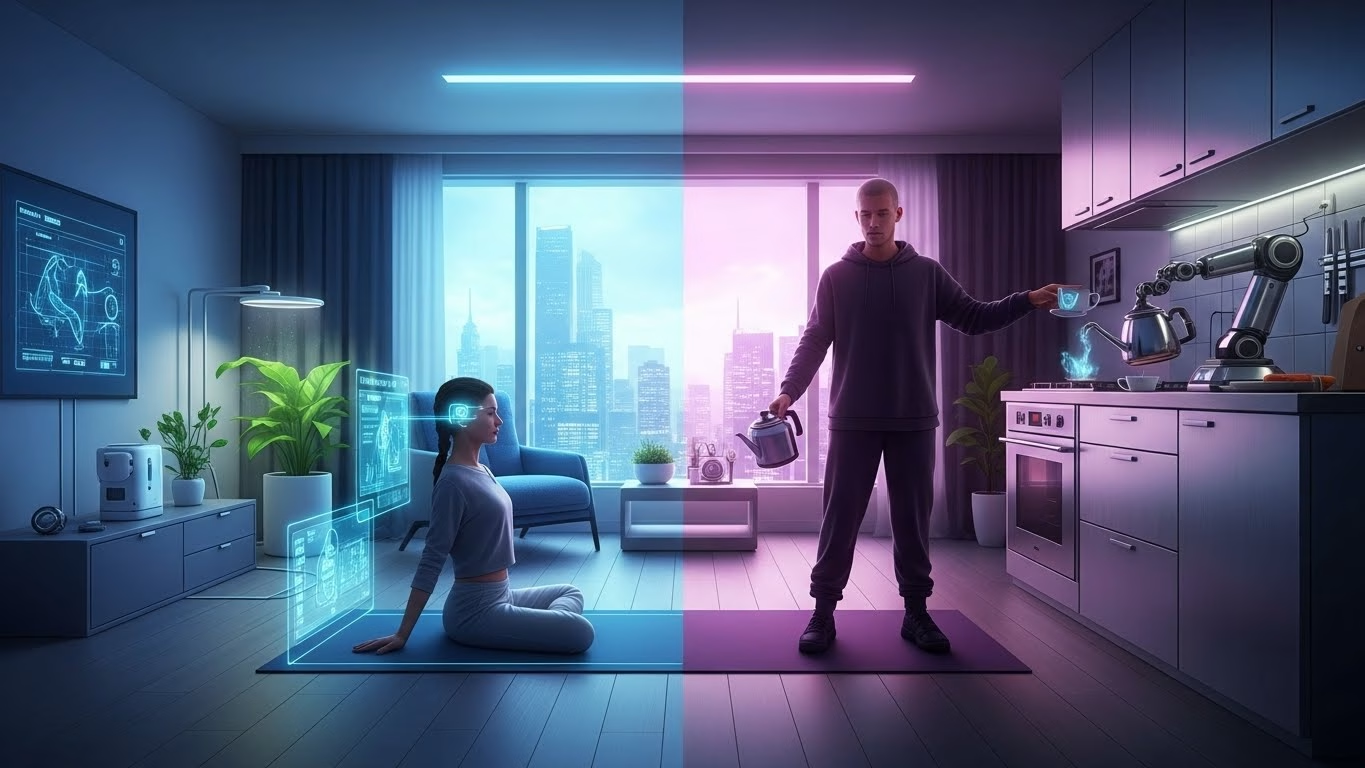
Has Technology Made Life Easier or Exhausting? The Expert Verdict 2026


Has Technology Made Life Easier or Exhausting? The Expert Verdict on Digital Life
Has Technology Made Life Easier or Exhausting? It is arguably the most fundamental question of the modern era, one that defines the core paradox of the 21st century. On one hand, a single tap can order groceries, coordinate global projects, or summon a ride, unequivocally establishing technology as the unparalleled engine of convenience. Yet, paradoxically, survey after survey confirms a widespread, gnawing feeling of being perpetually overwhelmed, relentlessly “on,” and deeply tired—a sensation that directly correlates with the rise of the digital landscape.
As expert observers of the confluence between cognitive science and technology, we understand that the ease offered by these tools often comes with an unforeseen, massive cost: cognitive load. The answer is not a simple ‘yes’ or ‘no,’ but a nuanced assessment of how unprecedented access to information and people has shifted the burden of effort from physical labor to mental processing. This comprehensive analysis will explore the deep-seated mechanisms of this productivity paradox, providing a framework for understanding and mastering the digital exhaustion that so many of us face today.
The Productivity Paradox: Has Technology Made Life Easier or Exhausting by Creating ‘Digital Fatigue’?
In theory, technology is the ultimate facilitator of rest; in practice, it often feels like an endless treadmill. The moment we discuss the question, Has Technology Made Life Easier or Exhausting?, we must first introduce the concept of Digital Fatigue Symptoms. This phenomenon is far more than just “screen time”; it is a state of mental exhaustion rooted in constant connectivity and the relentless demands of the attention economy. Every notification, every email, and every new feature on an app represents a micro-demand on our limited cognitive resources. When we navigate the digital world, our brains are not simply watching; they are constantly filtering, prioritizing, and switching context—a process known to dramatically increase cognitive burden.
For instance, consider the sheer volume of information overload. Historically, information scarcity was the challenge; now, it is abundance. While a search engine can instantly provide a thousand articles on any topic, the effort shifts to evaluating their authority, synthesizing the data, and deciding which source is trustworthy. This constant, low-level filtering creates a persistent state of low-grade stress, a psychological “always-on” state that mimics the symptoms of classic burnout syndrome. We may be sitting still, but our minds are sprinting.
The result is a pervasive feeling of being depleted, irritable, and unable to concentrate—the telltale signs of digital fatigue. Tech stress and the sense of perpetual obligation erode mental clarity, fundamentally challenging the notion that these tools inherently make our lives easier when their design actively promotes incessant engagement.
The Erosion of Boundaries: Is Constant Connectivity Truly ‘Easier,’ or Does it Just Blur the Lines?
The promise of technology making life easier was, in part, the promise of control and flexibility. The rise of remote work, powered by tools like Slack, Zoom, and shared documents, was supposed to unshackle us from the cubicle. While it delivered flexibility, it simultaneously ushered in the era of the always-on culture, directly challenging the argument that technology exclusively makes life easier. The convenience of connecting from home also meant the home became a second, permanent office. The boundaries between our professional and personal life integration have not just blurred; they have often evaporated entirely.
For many, this is the deepest source of digital exhaustion. The expectation of a perpetual obligation—the ability to respond to an email at 10 PM or take a meeting on a Sunday—is a silent contract negotiated by constant access. Without the physical separation of an office, setting professional boundaries becomes a constant, conscious effort rather than a default. Furthermore, this dynamic is amplified by social media pressure.
Platforms initially designed for connection now function as curated highlight reels, creating a constant sense of comparison and inadequacy. The mental gymnastics required to maintain a performative online presence, combined with the feeling of missing out (FOMO) when disconnected, adds a significant, self-imposed psychological weight. Therefore, while technology excels at the task of communication, it makes the management of personal time and mental space infinitely more difficult.
Beyond the Screen: Hidden Physical and Mental Costs That Make Digital Life Exhausting.
The exhaustion associated with the digital age is not confined to our minds; it manifests profoundly in our bodies, serving as a powerful counter-argument to the idea that technology has uniformly made life easier. When considering the health effects of screen time, most people immediately think of eye strain—the dry, irritated eyes that accompany long work sessions. However, the costs are far more systemic. Extended periods of sitting, driven by digital device use, contribute to a global increase in sedentary behavior, leading to posture problems, chronic back pain, and metabolic issues.
More critically, the light and interaction patterns of devices directly interfere with essential biological functions. Exposure to the blue light emitted by screens suppresses melatonin production, leading to severe sleep disruption. A poor night’s sleep is the single greatest precursor to daytime cognitive decline, memory problems, and irritability, making subsequent efforts—digital or otherwise—feel genuinely exhausting.
From a psychological perspective, our addiction to the ping of a notification is tied to the brain’s dopamine cycle. Apps are expertly engineered to deliver unpredictable rewards, trapping us in a habit loop that overstimulates our reward centers. This constant stimulation leaves the brain over-aroused and less capable of enjoying low-dopamine activities like quiet reading or simple conversation.
To combat this, the strategic use of digital well-being apps and features has become necessary not just for optimization, but for basic mental hygiene—a step that would be unnecessary if the technology were purely designed to make life easier. The cumulative effect of these physical and psychological costs strongly supports the view that the digital life, left unchecked, is ultimately an exhausting one.
Data vs. Intuition: Why People Feel More Exhausted Even as Technology Makes Tasks Easier.
This section dives into the core philosophical problem of the question, Has Technology Made Life Easier or Exhausting? Objectively, data proves that technology makes tasks easier. Complex calculations are instantaneous, navigation is effortless, and research is centralized. Yet, our intuition screams that we are more tired than ever. This divergence is explained by the “simplification paradox” and the role of decision fatigue.
When technology provides us with endless options—for dinner, for a movie, for a file-sharing method—it is creating what experts call “curation labor.” The technology has automated the task, but it has left the much harder work of cognitive load—the decision—squarely on our shoulders. Deciding between 20 streaming options or 5 different project management tools is significantly more exhausting than dealing with the limited choice sets of the pre-digital age. The automated tasks have merely pushed the effort up the chain from physical execution to mental selection.
We are experiencing technology ease vs effort in a zero-sum trade-off. While our time-saving tools shave minutes off manual processes, the constant exposure to micro-decisions rapidly depletes the mental energy required for high-level thought, creativity, and strategic planning. Furthermore, the reliance on these systems erodes our trust in natural human intuition. When a GPS fails, or a critical file is lost in the cloud, the subsequent panic is far more intense than the inconvenience of simply forgetting a map or misplacing a physical folder. The feeling of being dependent on these complex systems, which require a constant stream of low-level monitoring, explains why a life filled with “easy” technology can paradoxically feel so overwhelmingly effortful and exhausting.
The Solution: Mastering Digital Well-being to Tip the Scale Towards ‘Easier.’
Ultimately, the answer to Has Technology Made Life Easier or Exhausting? rests not with the tools themselves, but with the user—us. The critical insight is that true ease is found through agency and intentionality. To shift the scale from exhaustion back toward genuine simplification, we must actively pursue digital detox strategies and reclaim control over our devices.
This begins with proactive notification management. Every notification is a deliberate interruption designed to pull you out of focus. Turning off all non-essential pings—especially for social and news apps—is the single most effective step toward reducing cognitive burden. Furthermore, the practice of intentional use is key. Instead of passively scrolling, define a purpose before opening an app. If you pick up your phone to check the weather, check only the weather, then immediately put the phone down.
Successful digital well-being also requires setting physical and time-based boundaries. Implement designated screen time limits for leisure apps and enforce digital boundaries like a “No Phones at the Dinner Table” or “Device-Free Hour Before Bed” rule. Embracing low-tech hobbies—anything that engages your hands and mind without a screen, from cooking to gardening to journaling—helps re-regulate your dopamine system and allows your mind to rest naturally. The goal is to establish a clear hierarchy: technology should serve your goals, not dictate your behavior. By applying these deliberate strategies, we can harness the power of technology to genuinely simplify our lives without paying the steep cost of perpetual exhaustion.
The Verdict and Path Forward
When we weigh the evidence, the verdict on the question Has Technology Made Life Easier or Exhausting? is clear: it has done both, simultaneously. Technology is a powerful amplifier—it makes easy things easier, but it makes boundaries harder. The core problem is not the code, but the culture of constant availability and the subtle yet relentless cognitive load it imposes. To create a life that feels genuinely easier, we must move from passive consumption to active, masterful utilization. The future belongs to those who understand that in the digital world, the greatest form of productivity is knowing when, and how, to disconnect.
Frequently Asked Questions (FAQs)
Q1. What is the definition of ‘Digital Fatigue’?
- Digital Fatigue is a recognized state of mental and physical exhaustion caused by the continuous and excessive use of digital devices and the resulting information overload, constant connectivity, and cognitive burden of context-switching. It is characterized by difficulty concentrating, irritability, and a feeling of being perpetually overwhelmed.
Q2. How does the ‘always-on’ culture impact work-life balance?
- The always-on culture, driven by mobile access to work communications (email, Slack), erodes the psychological and physical boundaries between work and personal life. It fosters an expectation of immediate responsiveness, leading to longer working hours, higher stress levels, and reduced quality time away from professional duties, making recovery from work-related stress more difficult.
Q3. Is technology actually making us less efficient despite the speed of tools?
- In many cases, yes, due to the phenomenon of decision fatigue. While technology speeds up execution, it vastly increases the number of choices and streams of information we must process. This constant low-level decision-making and filtering depletes our mental reserves, making us feel more exhausted and less capable of deep, focused work, which is the definition of true efficiency.
Q4. What is the most effective E-E-A-T-based strategy for reducing screen-related exhaustion?
- The most effective strategy involves behavioral science: establishing firm, non-negotiable boundaries, especially around sleep. Stop all screen use (especially social media and work email) at least 60 minutes before bedtime. This allows the brain to transition naturally into sleep, improving rest quality, which is the foundational pillar for managing cognitive load and exhaustion during the day.