
Intel SambaNova Acquisition: The $1.6 Billion AI Chip Deal That Could Change Everything

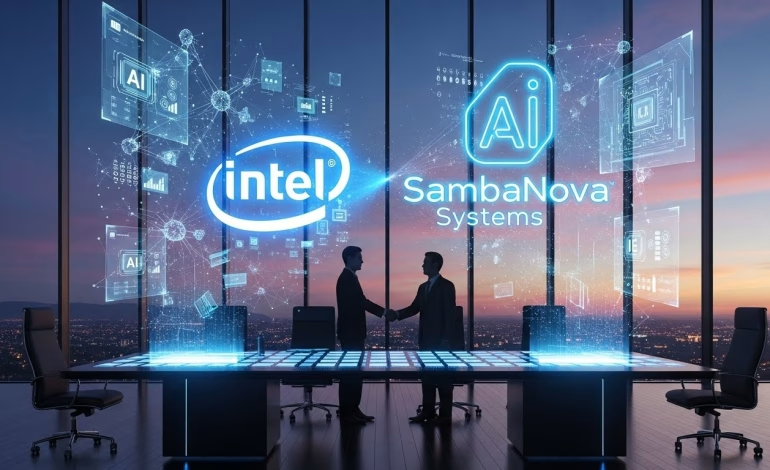
The Intel SambaNova acquisition marks a pivotal moment in the rapidly evolving artificial intelligence (AI) hardware landscape. For Intel, this acquisition is more than just a business move—it’s a crucial step in its attempt to regain relevance in AI, a field where the company once dominated but has since struggled to keep pace with industry leaders.
What Is the Intel SambaNova Acquisition?
In a bold move, Intel Corporation has signed a term sheet to acquire SambaNova Systems, a Palo Alto-based startup specializing in AI chips. This acquisition, which was first reported by WIRED and confirmed by multiple sources, highlights Intel’s recognition that it can no longer compete with industry giants like Nvidia through traditional methods.
This acquisition is particularly notable given SambaNova’s trajectory. Once valued at $5 billion, the company’s current valuation has dropped to around $1.6 billion—an indication of the challenges it has faced in a market dominated by Nvidia’s powerful GPUs and CUDA ecosystem.
The Fall From Grace of SambaNova
SambaNova’s founders, Kunle Olukotun and Christopher Ré, both Stanford professors, along with former Oracle veteran Rodrigo Liang, initially had grand ambitions to disrupt the AI chip market. Their focus was on AI inference, the process that allows AI models to make real-time decisions after being trained. This approach was designed to offer an alternative to Nvidia’s dominance in AI training, with the goal of becoming a leading player in AI acceleration.
However, despite an impressive Series D investment from SoftBank that valued the company at $5 billion, SambaNova has faced significant struggles. Nvidia’s entrenched position, combined with its CUDA software ecosystem, has made it nearly impossible for specialized companies like SambaNova to gain a foothold in the market. As a result, what was once a promising startup is now preparing to sell itself at a fraction of its peak value.
Why Is Intel Buying SambaNova?
Intel’s acquisition of SambaNova represents a recognition that the company needs to act swiftly to avoid becoming irrelevant in the AI race. Once a leader in computing, Intel now finds itself in an existential crisis. Its data center revenue has been under siege by AMD’s EPYC processors, and its manufacturing processes have been overshadowed by TSMC and Samsung.
For Intel, acquiring SambaNova is not just a purchase of technology but an acquisition of time. Rather than developing competitive AI inference technology from scratch—an effort that could take years—Intel gains immediate access to SambaNova’s technology, customer base, and engineering talent.
Challenges in Integration
However, this acquisition is not without its challenges. Intel’s history with acquisitions has been rocky, with past failures such as the Altera and McAfee purchases. The integration of SambaNova’s unique technology, especially its Reconfigurable Dataflow Unit architecture, into Intel’s traditional processor designs will be no easy task. There is also the cultural divide between SambaNova’s startup mentality and Intel’s more hierarchical structure.
Implications for the Industry
If the Intel SambaNova acquisition goes through, it could dramatically transform the AI chip industry. For Intel, this acquisition marks its entry into the AI market, an area where it has previously been noticeably absent. This strategic move also highlights the growing trend of consolidation in the AI chip sector, as smaller specialized startups find it increasingly difficult to compete against Nvidia’s stronghold.
Intel’s entry into this market, bolstered by SambaNova’s technology, could also pose a challenge to AMD—which has been gaining traction in AI training and inference. While Nvidia remains the undisputed leader, the acquisition may allow Intel to compete for a share of the second-tier market that is increasingly looking for alternatives to Nvidia.
Regulatory and Integration Hurdles
The acquisition does face its challenges. Like any major deal, it will need approval from various regulatory bodies, which could pose potential delays. The ongoing U.S.-China tensions, for example, might complicate matters, especially since SambaNova has clients in China. Additionally, the European Union has become more vigilant in reviewing AI-related acquisitions, particularly when they involve key players like Intel and SambaNova, which could add another layer of scrutiny to the deal.
Intel’s track record with acquisitions has been underwhelming, and the integration of SambaNova’s technology will be closely watched by investors, analysts, and industry stakeholders alike.
What’s at Stake?
The outcome of the Intel SambaNova acquisition could be a game-changer for the semiconductor industry. If successful, Intel will have the opportunity to revitalize its position in AI and compete with the likes of Nvidia and AMD. However, the real challenge lies in the execution—whether Intel can integrate SambaNova’s technology, retain key talent, and deliver a product roadmap that makes sense for its diverse customer base.
FAQs About the Intel SambaNova Acquisition
Q: What exactly is SambaNova Systems and why does it matter?
SambaNova is an AI chip startup founded by Stanford professors, specializing in AI inference computing—the technology that helps AI models make real-time decisions.
Q: How much is Intel paying for SambaNova?
The acquisition price is approximately $1.6 billion, a sharp decline from SambaNova’s peak valuation of $5 billion in 2021.
Q: Why is Intel’s CEO also chairman of SambaNova?
Intel’s CEO, Lip-Bu Tan, was an early investor in SambaNova and chaired its board prior to becoming Intel’s CEO. This relationship played a key role in facilitating the acquisition discussions.
Q: Can Intel compete with Nvidia in AI chips after this acquisition?
While the acquisition gives Intel a foothold in AI, Nvidia’s dominance remains strong. Intel will compete for second-tier market share, not directly challenge Nvidia’s leadership.
Q: When will the acquisition be finalized?
The deal is still in its early stages. Intel and SambaNova have signed a non-binding term sheet, meaning the finalization is contingent upon regulatory approvals and further due diligence.
Final Thoughts: A Last Ditch Effort or Strategic Masterstroke?
The Intel SambaNova acquisition could be a turning point for both companies. For Intel, this represents one last shot at securing its place in the future of AI. For SambaNova, it’s a necessary retreat to survive in an increasingly cutthroat market. Whether or not this deal succeeds will depend on how well Intel integrates SambaNova’s technology and adapts to the fast-moving world of AI hardware.
The story of the Intel SambaNova acquisition reflects the broader challenges facing the semiconductor industry as it grapples with the growing importance of AI. In this rapidly evolving market, Intel’s willingness to embrace change could ultimately determine whether the company can reclaim its competitive edge.







2 Comments
https://shorturl.fm/7qlu6
https://shorturl.fm/RSdfC